
Exhibitions
Mammals of the Deep | The Wonderful World of Marine Mammals in the Mediterranean and in the Gulf of Eilat
Now at the Museum
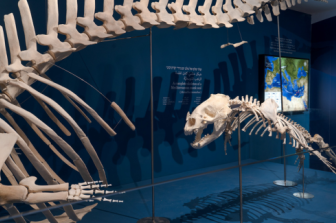
This exhibition is a product of this special bond between humans and nature. Specimens that indicate a highly diverse presence of marine mammals in our region have been brought to the museum for the very first time. Marine mammals of the Mediterranean and of the Gulf of Eilat, which is, in fact, an extension of the Indian Ocean, include various species of cetaceans (whales and dolphins) and one species of seal. The telltale findings that testify to their presence have been collected by a very special group of people, members of IMMRAC, who devote their time and energy to the task of studying the world of marine mammals and assisting in the protection of their habitat.
Saturday, 26.06.27

Community House | The Templers: Legacy and Dream
Now at the Museum
This exhibition is a showcase for artist Ossi Yalon, who has spent several years researching the long-gone community in the Land of the Bible. Her works focus on the stories of members of the community who played an important role in the history of Haifa, and left a rich and fascinating cultural impression on the city. Yalon’s art strives to revitalize the Templers’ way of life, and envisage their day-to-day routine, the cultural and social characteristics of their community, and the view they saw from their windows.
Saturday, 01.08.26

Let’s Build a Port | The Ports of Israel
Israel’s location along trade routes connecting three continents - Asia, Africa, and Europe - has given its ports historical significance. Until the early twentieth century, the ports of Jaffa and Acre were the country’s main ports, serving as gateways for passengers and cargo. These ports developed over thousands of years as organic parts of their cities, similar to other historical ports along the Mediterranean.
Blood - Money - Ships | The Reparations Agreement with Germany as a Catalyst for the Growth of the Israeli Merchant Fleet
Now at the Museum
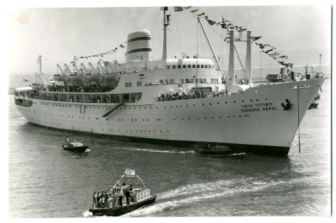
The exhibition displays models of several ZIM shipping vessels, designed for various purposes. The first ship received under the agreement, Dagan, was used for cargo, as was the Ampa'al. The ships Israel and Zion were intended for mixed use of passengers and cargo, while Jerusalem served as a passenger ship. The ship Har Gilad, owned by El-Yam company, was used for general cargo and refrigerated transport. The exhibition also features historical moments in the ships' stories, documented in sources including news diaries, photographs, and promotional leaflets.

Pirates - Between truth and legend
The phenomenon of piracy - piracy - has evolved since man began trading in ships, and it has flourished mainly in areas of loose rule. Piracy existed in ancient times in the Mediterranean and the Sea of China and reached its peak in the seventeenth century in the Atlantic Ocean, with the rise of European colonialism and the development of trade routes with the "New World".

Glassware in Antiquity
The secret of glassmaking was already known in the ancient world: take sand that is rich in silica, quartz, and potassium salts, heat it gradually to 1100 Celsius, and you will get an almost liquid, mailable material. Once the liquid has cooled down and solidified, you will have lumps of raw glass that can be remelted and fashioned into vessels and jewelry.

We’re on the Map! Cartography—The Art of Mapmaking
Cartography, the science of maps and mapping, is an ancient craft that may even predate the invention of writing. Already in antiquity, maps of cities and countries had been drawn up in various civilizations around the world, such as China, Mesopotamia, and Greece.
Look to the Horizon | Gallery for Families
New exhibition
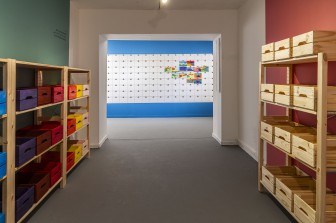
In the exhibition Northern Horizon, you can see paintings by well-known artists depicting landscapes. Most of them painted the scenery with large fields of color that fill only a few simple shapes. It may seem easy to capture a beautiful, interesting place with only a few shapes and colors, but if you try it yourself, you'll discover that it can be more challenging than it looks. You are now entering the artist’s studio, a place filled with original ideas and creative materials. Think of a place you love, or a place you would like to visit, and create it yourself.
Saturday, 27.06.26

Transportable | Faina Feigin Landau
New exhibition
A massive wave of immigration from the former Soviet Union and Ethiopia profoundly reshaped Israel's social landscape during the turbulent 1990s. In response to the country's housing crisis caused by the growing influx, temporary residential neighborhoods known as 'Caravan Sites' were established to accommodate the newly arrived immigrants. As many as 30,000 mobile homes were installed in various locations throughout Israel, including Haifa, and soon developed into immigrant communities. Those neighborhoods and the lives forged within them, through challenges and hardships, constitute an important chapter in the history of Israel and the city of Haifa.
Saturday, 01.08.26

Here, There, and Nowhere
New exhibition
The exhibition Here, There, and Nowhere explores representations of landscape in works from the Haifa Museums' collections and invites viewers to move between the familiar, the Other, and the unknown. This exhibition showcases the dynamic visual language of printmaking, its various techniques, and how this medium is used to interpret and examine space.
Friday, 06.11.26